Screen Time Rules by Age: A Parent’s Complete Guide
Last updated: August 10, 2026
- Most parents underestimate actual screen time by around 30–50% — that number surprises people every time.
- The WHO recommends no sedentary screen time at all for children under 1, and under 1 hour per day for ages 3–4 (2019 guidelines).
- iOS Screen Time and Android Digital Wellbeing studies consistently find parents underestimate their child’s daily screen use by 30–50%.
- 18–24 months: High-quality programming only, watched with a caregiver who narrates and explains.
- Children under 18 months show a measurable video deficit effect — they learn words roughly 50% less efficiently from screens than from live interaction, according to developmental psychology research.
- The AAP sets no daily hour limit for children aged 6 and over; the 2-hour figure widely cited in popular media applies only to under-fives.
- The WHO recommends no sedentary screen time at all for children under 1, and under 1 hour per day for ages 3–4 (2019 guidelines).
- Multiple studies link bedroom phone use to delayed sleep onset and reduced total sleep in adolescents by an average of 20–60 minutes per night.
- iOS Screen Time and Android Digital Wellbeing studies consistently find parents underestimate their child’s daily screen use by 30–50%.
- For children with ADHD or autism spectrum conditions, rigid time limits may remove a coping mechanism — consult a paediatric occupational therapist before applying neurotypical guidelines.
- Screen time rules by age work best as a starting framework, not a fixed prescription; a family review every 3–6 months is recommended as children’s needs change.
Your seven-year-old has been on the iPad for two hours. Your teenager disappeared into their room with a laptop at noon — it’s now dinnertime. You feel the pull to say something, but you’re not sure what the right limit actually is, or whether the limits you’ve heard about are real guidance or just guilt in disguise. This guide sets out what the evidence actually supports, what it leaves open, and how to translate it into rules that work for your specific child.
Rules around screen time by age do exist, and they are grounded in developmental research. They are also far more conditional than most articles admit. Here is what the evidence supports, what it leaves open, and — honestly — how to set rules that work for your actual child rather than a hypothetical average one.
What the Major Health Bodies Actually Say (and What They Leave Out)
The American Academy of Pediatrics and the World Health Organization both publish age-based guidelines, and they broadly agree on the following:
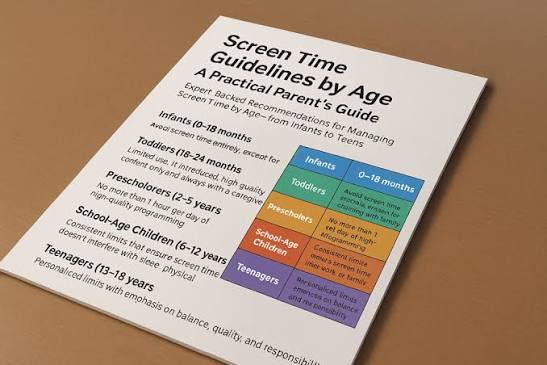
- Under 18 months: No screen use except video calls.
- 18–24 months: High-quality programming only, watched with a caregiver who narrates and explains.
- 2–5 years: No more than one hour per day of high-quality content.
- 6 and up: Consistent limits on time and type, with priority given to sleep, physical activity, and face-to-face interaction.
Both bodies offer a useful starting framework, but they address the typical child in a typical week. Neither attempts to answer what happens when your five-year-old’s school sends homework through an app — increasingly common, with one 2022 survey finding over 60% of UK primary schools using tablet-based homework platforms — or when a device is the only thing that manages a child’s anxiety enough to get through a hard afternoon. Real families need something more conditional than a single number.
Quick check: Neurotypical child, stable routine? These ceilings are solid starting points. Significant variables in your household — disability, single-parent setup, screens used for communication? Read on before applying them.
Screen Time Rules for Toddlers and Preschoolers (Ages 0–5): Where the Stakes Are Highest
The guidelines are strictest here for a reason. Before age two, a child’s brain cannot reliably transfer learning from a screen to the real world — that’s the video deficit effect, documented across multiple developmental psychology studies including foundational work by Georgene Troseth at Vanderbilt University. Watching a character point at a cup does not teach a toddler the word “cup” as effectively as a person doing it in the same room. The gap is roughly 50%. That’s not a small rounding error.
The one exception — video calls — isn’t a concession to convenience; it’s genuinely different. A grandparent on FaceTime is a responsive, interactive conversation partner. A YouTube algorithm is not.
Ages 2–5: One hour is the ceiling, not the target. A day with no screens at all is not a failure. Forty-five minutes of Bluey watched together while you explain what’s funny is probably fine; forty-five minutes of unsupervised tablet time at that age is a different thing entirely — the content and the co-viewing matter as much as the clock.
Even so, enforcing these limits is hardest during the years when caregivers are most exhausted. A parent working from home with a three-year-old and no childcare is not failing their child by letting CBeebies run for ninety minutes. The research is about averages across development, not about a single hard day. Because of that, the priority for exhausted caregivers is preserving the overall pattern — co-viewing when possible, consistent bedtimes, daily outdoor time — rather than hitting an exact daily minute count.
Quick check: Counting educational app use assigned by nursery? That probably shouldn’t count against the entertainment ceiling — but it still counts against total sitting time, and that matters too.
Screen Time for School-Age Children (Ages 6–12): When “Limits” Need to Get Specific
Once children reach school age, the rules shift meaningfully. The AAP stops giving a single daily number because the evidence stops supporting one. Consistent family rules protecting sleep (9–11 hours for ages 6–12), at least 60 minutes of physical activity daily, and homework — that’s the framework. Not a cop-out. It reflects real variability: a ten-year-old who reads for an hour, plays outside after school, sleeps nine hours, and then watches an hour of television before bed is doing well. The raw total is four hours. Whether four is “too much” is, in that context, the wrong question.
| Situation | Best Path | Why Other Options Fail |
|---|---|---|
| Child uses screens mainly for passive entertainment (YouTube, streaming) | Set a daily ceiling of 1–2 hours on entertainment screens; use parental controls on platforms like YouTube Kids or Apple Screen Time to enforce it | Relying on self-regulation alone tends to fail at this age — the platforms are designed by adults to defeat adult self-control, let alone a child’s |
| Child uses screens for creative or educational work (Scratch, reading apps, drawing) | Don’t count this toward entertainment limits; track it separately and monitor for signs of obsession rather than hours | Applying a blanket two-hour rule discourages genuinely productive engagement and teaches children that screens are inherently bad rather than context-dependent |
| Child’s social life increasingly requires screens (group chats, gaming with friends) | Allow a reasonable social window (30–60 min on school nights) and treat it as you would any other social activity — with some structure but not prohibition | Banning it entirely can cause social exclusion that damages peer relationships; ignoring it entirely means no oversight of who they’re talking to |
| Screen time is expanding into sleep hours | Device-free bedrooms, chargers outside the room — strongly recommended at this age, and easier to establish now than in the teenage years | Bedtime screen rules in this age group tend to drift later over time without a physical barrier like a bedroom charging station |
Quick check: Are screens displacing sleep, movement, or in-person connection with people your child cares about? Cut it. Coexisting with those things? The raw number matters less than you think.
Screen Time Rules for Teenagers (Ages 13–18): Why the Standard Advice Often Misses the Point
Most guides go off the rails here. They apply the same “set limits” framework to teenagers that works for eight-year-olds — and it tends to fail because the developmental task of adolescence is autonomy. A fourteen-year-old with all screen time controlled by parental software is being denied the practice of self-regulation at exactly the age they need to develop it.
No rules at all? That’s not the answer either.
The rules simply change form. When a teenager is using screens reasonably, time caps are probably the wrong tool. A better conversation is about what they’re doing and whether it’s working for them — sleeping enough, keeping up socially offline, doing things they actually care about? An hour count adds friction without benefit when those boxes are ticked.
Genuinely problematic use looks different: sleep disrupted, grades sliding, irritability offline, cancelling in-person plans to stay on a device. At that point, the issue is likely not screen time in isolation — it may be anxiety, depression, social difficulty, or boredom from an under-stimulating environment, all of which screens can both cause and mask. A screen limit addresses the symptom rather than the cause; the evidence-based step is a direct conversation and, where it continues, a referral to a GP or adolescent psychologist (see the Royal College of Psychiatrists guidance on screen use and adolescent mental health).
Despite the case for flexibility, one rule holds consistently at this age: phones out of bedrooms at night. Research connecting phone use in bed to disrupted adolescent sleep is consistent across multiple studies — including a 2019 JAMA Pediatrics analysis covering over 125,000 children — and this is not really a judgment call. A charging station in a common area is not a punishment; it is sleep hygiene that protects the 8–10 hours teenagers need.
Quick check: Is the conflict actually about screens, or are screens a proxy for a deeper disagreement about control and independence? Knowing which one you’re dealing with changes the approach completely.
When Normal Screen Time Rules Break Down: Edge Cases That Require a Different Playbook
- Child has ADHD or autism spectrum condition. Structured video games or niche-interest content can provide genuine regulation and focus for some children. Rigid time limits cut off a coping mechanism before the child has alternatives. Shift the conversation from “how long” to “is this helping you regulate or making things worse?” Work with a paediatric occupational therapist or psychologist rather than applying neurotypical guidelines.
- Family is in crisis or transition (bereavement, divorce, illness). Screen time goes up during hard periods. Normal. A temporary increase during a difficult stretch is not going to override healthy development. Energy is better spent on the relationship than on the time limit — reconnect when things stabilise.
- Child is highly gifted or deeply passionate about a screen-based pursuit. A twelve-year-old coding for four hours because she’s building something real is not the same as a twelve-year-old watching four hours of unrelated YouTube. The research on “screen time” draws from broad population averages; it was not designed to capture deep, purposeful engagement. Evaluate on output and wellbeing, not hours.
- All of the child’s socialising happens online. This became common during the pandemic years and hasn’t fully reversed for some children and teenagers. The social connection is real even when the medium is digital. Cutting screen time without addressing the underlying social isolation tends to make things worse. Build in-person social opportunities alongside managing screen use — not instead of it.
- You are a single parent or your child lives across multiple households. Consistent rules across households are ideal; they are also often impossible. A child with strict limits at your house and none at the other parent’s house will notice — and, to be fair, it will create conflict. Aim for consistency on the one rule that matters most — keeping devices out of the bedroom at night — and let the rest be ongoing conversation rather than a battleground.
- Your child’s school uses screens heavily. Three or more hours of school-assigned device work, plus a two-hour entertainment ceiling, produces a child on screens for five or six hours daily while technically “following the rules.” Count total screen exposure, not just entertainment. Advocate at school level for offline alternatives where possible, and build in screen-free recovery time after school before entertainment screens begin.
Three Principles That Hold Across Every Screen Time Rule, Every Age
After all the conditionals, three principles hold regardless of age, child, or family structure. Not absolute guarantees — every child is different — but these represent the most consistent findings across the screen time research.
1. Sleep comes first. No screen time rule is worth keeping if it costs a child sleep. Devices out of bedrooms at bedtime — for every age, teenagers included — is the single rule most strongly supported by the evidence. Keep only one rule by age, and make it this one.
2. Passive consumption carries higher risk than active engagement. An hour building in Minecraft, coding on Scratch, or calling a friend is developmentally different from an hour of autoplay video. Both register the same on a clock. They do not have equivalent effects on attention, creativity, or social development.
3. The relationship matters more than the rule. A child who trusts that your concern is genuine — not just about control — is more likely to self-regulate as they get older. That doesn’t mean letting them do whatever they want. It means explaining why the rules exist in language that actually makes sense to them, at their age.
Setting Up a Family Screen Time System That Actually Holds
- Audit current use for one week before setting any new rules. Most parents underestimate actual screen time by around 30–50% — that number surprises people every time. iOS Screen Time and Android Digital Wellbeing both provide accurate tallies; use them before you act.
- Separate screen types: entertainment, educational, social. Set separate expectations for each category rather than one blunt daily total.
- Decide on your non-negotiables first (no phones at meals, phones charged outside the bedroom overnight, no screens until homework is done) and hold those firmly.
- Beyond that? Involve the child in setting the rules from around age six. A limit they helped design is more likely to stick than one handed down — that’s a well-documented finding in behavioural research on compliance, not just optimistic parenting advice.
- Build in a review date — every three months for younger children, twice a year for teenagers. Needs change; a screen time rule that made sense at eight can become counterproductive at ten.
- Use platform tools consistently: Apple Screen Time, Google Family Link, and router-level controls like Circle (around £79–£99 for the home device) are imperfect but useful for younger children. Expect workarounds as they get older. The tools supplement the conversation; they don’t replace it.
FAQ
Is two hours a day of screen time actually dangerous for school-age children?
Not in most circumstances — provided sleep, physical activity, and direct social connection are intact. The two-hour figure originates in guidelines for under-fives and has been misapplied to older children across a lot of popular media. The AAP explicitly does not specify a daily hour limit for school-age children and teenagers; their recommendation centres on consistent family rules focused on those priorities instead.
Does educational screen time count toward the limit?
For preschoolers, yes — total sitting time in front of a screen matters regardless of content quality. For school-age children and teenagers, tracking it separately makes more sense; focus limits on passive entertainment use rather than blending everything into one total.
My child says all their friends have no screen time limits. How do I handle that?
This is real, and dismissing it doesn’t help. Acknowledge that different families have different rules, explain yours in terms the child can understand (sleep, balance, the research basis when they’re old enough), and hold the boundary. Peer comparison pressure is normal — it’s not, by itself, a reason to abandon a reasonable approach.
At what age should I stop monitoring my child’s screen content?
No single right answer exists, but the direction of travel should be toward more autonomy as they demonstrate good judgment. By mid-adolescence, directly monitoring content tends to damage trust more than it protects safety. At that point, the ongoing conversation and the relationship become the main tool.
What if my child has a complete meltdown when screens are turned off?
Common in younger children — and not necessarily a sign of screen addiction. Transition difficulties are a normal part of early childhood. Build in five-minute warnings, create a consistent off-routine, and don’t read distress as evidence the rule is wrong. Extreme, weeks-long distress is worth discussing with a paediatrician; a typical protest is not.